Wednesday, May 22, 2024

Paleo Places - Chapter 3


Chapter 3:  Paleo People


The so-called Paleo period is key to understanding our reactions to environment for a couple major reasons.  First, we evolved into modern homo sapiens sapiens during this time, and secondly as you will see in Chapter 1, this thin veneer of civilization that you see around you aside, man has actually spent the vast, VAST majority of his time on Earth living in Paleo environments.


Modern Man, or homo sapiens sapiens, evolved on the African savannah around 200 thousand years ago.  The Agricultural Revolution that led to the widespread advent of the first towns and then cities happened about 10 thousand years ago.  These numbers – 200 thousand and 10 thousand are important…look at the ratio between the numbers – 20:1.  This ratio means that Man has spent almost twenty times as much of his existence as a hunter-gatherer as he has in towns and cities.  To look at it another way, Man has spent 95% of his time living is small bands – and then only the past 5% living in Agricultural, and very recently, Industrial cities.


Man evolved on the African savannah and his likes and dislikes and ways of doing things evolved there too.  Are we talking about instincts?  Not quite.  There are characteristics common to all groups – even isolated groups –  of humans.  Fire-making is one such characteristic.  Everyone all over the planet does it…but, you couldn’t really call fire-making an instinct.


In his book by the same name, Donald Brown calls these characteristics “Human Universals.”  I have included Brown’s list of Human Universals in the Appendix of this book.  It is fascinating.


Brown’s Human Universals are a great place for us to start our quest for, and understanding of, what humans really need and want in their built environments.


In subsequent chapters of this book we will be developing a running list of “Characteristics of Paleo Places.”  The aim of this chapter is to convey that Human Universals do exist, and that they do have Paleo roots.  Along the way, we are going to take up a detailed discussion of the human need for art, citing a book, “The Art Instinct”,” by Dennis Dutton.  But, for now, I want to share what he says about the Paleo roots of some of our societal characteristics in this quote from “The Art Instinct.”

“…the Pleistocene itself – the evolutionary theater in which we acquired the tastes, intellectual features, emotional dispositions, and personality traits that distinguish us from our hominid ancestors and make us what we are – was eighty thousand generations long.”


This last by Dutton, where he points out that this phase of our development lasted 80 thousand generations, re-emphasizes just what a long, important period of societal evolution we are discussing.


Another important source that will be cited throughout this book is Steven Pinker’s “The Blank Slate:  The Modern Denial of Human Nature.”  With reference to the Pleistocene/Paleo period, here is what he has to say, “These ways of knowing and core intuitions are suitable for the lifestyle of small groups of illiterate, stateless people who live off the land, survive by their wits, and depend on what they can carry.  Our ancestors left this lifestyle for a settled existence only a few millennia ago, too recently for evolution to have done much, if anything, to our brains.” 


The take away is that although we now live in modern settings, our reaction to these towns and cities is still Paleo.  We must deconstruct what will work in a built environment. We can do this by developing a list of “Characteristics of Paleo Places” and then making sure those characteristics are present in our modern towns and cities. 


Paleo Places - Chapter 2

Chapter 2:  By Way of Background

Before I explain my epiphany, a few  definitions are probably in order…  First, Neo-traditional towns.  This trend is also referred to as “New Urbanism.”  One of the leaders of this movement, Andres Duany, was actually the designer of Celebration, Florida.  

These New Urbanists believe that the land use patterns that developed after WWII are not sustainable.  When the soldiers came home from the war and spawned what was to become the Baby Boom, America needed a place to house all those new families. Developers started buying and sub-dividing big tracts of land outside of the cities. Once the roof tops were in place, commercial developers started to build shopping centers, and later shopping malls, to meet the consumer demands of this new population. 

This type of spread-out development would not have been possible at earlier points in history because the land uses were so geographically separated.  Dads were commuting into the cities for work; the shopping centers were miles away from the homes. But, the economic boom that followed World War II had made auto ownership available to many families.

Over time, it started to become apparent that these new land use patterns were not the panacea that they had first seemed to be. Traffic had become a nightmare. The abandoned city centers began to die. Childhood obesity even became a problem, in part because American children were driven everywhere!

Enter, the New Urbanists. They espoused the idea that tighter Pre-World War II development patterns had been better. And, they set about trying to re-create them. 


Some characteristics of a New Urbanist, or Neo-traditional, development include: 
• Streets in a grid pattern, including alleys for garbage cans etc. - as opposed to the meandering streets of suburban subdivisions.
• Old-fashioned front porches on houses.
• A “walkable” downtown area that pedestrians can reach from their homes, and that is dense, so pedestrians can easily walk from shop to shop.

This movement is sweeping the country – and beyond.  Prince Charles has actually been involved in a Neo-Traditional development – Poundsbury – in the United Kingdom.  Everyone is jumping on the New Urbanism bandwagon.  But, is it a good idea?   I do not think that it has been studied nearly enough given both the financial costs involved with constructing entire towns, and the long-term social implications associated with where we live and raise our kids.

To me, New Urbanism smacks of “casting about.”  Post World War II sprawl was “bad,” so we “cast about” for something better.  Pieces of pre-war cities were, of course, still around to serve as examples.  They seemed better than the new parts of town – the sprawling new ‘burbs..  Also people have a tendency to mythologize their own childhoods, which were likely spent in a more Mayberry-esque place than they are now lining.  And so, “BOOM” New Urbanism was born, and Neo-traditional towns came on the scene.

Then, almost immediately, the muttering started.  My son, Josh, was not the first person to call Celebration “creepy” or “scary.”  As a planner, I was always intensely interested when I heard this kind of talk.  In an old Tampa weekly, I had once seen Celebration described as Marie Antoinette’s court, where rich people were playing at being shepherds and milkmaids.  I took this criticism as a hint of a problem; a piece of a puzzle…  The article was pointing at a certain “fakeness” about the place.  But, I wondered when I got Josh’s impressions – why did “fakeness” beget “creepiness” and “scariness”?


Again, as a planner, I really wanted to understand why these emotions were coming up for people in relationship to these urban environments.  Creepy and scary are, of course, words associated with the primal emotion FEAR.
As I said earlier, my son and his friends certainly did not running screaming out of Celebration, Florida.  The place is not overtly terrifying.  It evokes more of a not-quite-tangible under-current of something...disturbing.
Andres Duany and company, the designers of Celebration also designed Seaside, Florida.  Not at all coincidentally, Seaside was chosen as the set for the movie, “The Truman Show.”  


 Caption:  Seaside, Florida...the perfect setting for the dystopian movie, 'The Truman Show.'


Caption:  The Post Office at Seaside.


“The Truman Show” is a movie about a man who is being tricked.  Unbeknownst to him, he is living on a television sound set in a fake town – Seaside.  His friends and family are all fake, and nothing is as it appears to be.  Seaside is creepy.
These were the concepts that I was pondering on that fateful dog walk with Jazzy.  I could certainly understand why people associated new towns like Celebration and Seaside with fakeness.  But, what was the connection between fakeness and those feelings of creepiness, apprehension, and, yes, fear that I had repeatedly seen and heard with reference to Neo-traditionalism?


Here's what I figured out.  Fear is a primal emotion.  It was hard-wired into man - and actually into his evolutionary ancestors - at the dawn of time.  As I mentioned earlier, I had been collecting old site plans and pictures of old cities - Roman, Medieval, etc. - trying to distill a set of elements common to all civilizations.  But, part of my epiphany was that I was not looking far enough back in time!  Not nearly far enough!

I suddenly realized that in order to find out what type of environment man was hard-wired for, I had to go back to the time of his hard-wiring in the Pleistocene Period.  (Note that I use the terms Pleistocene and Paleo relatively interchangeably in this book, but that the distinction is explained in the next chapter.)

The second part of my epiphany was a hypothesis about the how to connect the dots between the fakeness of Neo-Traditional developments and the creepiness/fear/apprehension that people often describe in relation to them.  As I walked my dog, I imagined very early humans walking - maybe with a dog that looked similar to our wolf-like Jasmine(!) - and coming upon the encampment of another group of people.  

Imagine you are part of the group too.  We come upon this little settlement, and something seems "off" about it.  Something does not look right.  You cannot put your finger on exactly what the problem is.  Things seem to be staged;  there seems to be some kind of trickery afoot...

And, we are walking right into the middle of it.

In this century, and in North America and Western Europe, most of us can move pretty blithely through our days - walking through cities, towns, shopping malls or subdivision without the fear of ambush by other groups of people or of animal attack.  But, that has not always been the case.  For our distant ancestors, walking into a settlement where things seemed unnatural or as though there was some deliberate attempt at trickery could have been the prelude to an attack!  

And, my thesis is that walking into these types of environments today sets off the same alarm bells that would have sounded for our "Paleo" ancestors - albeit the bells are now muffled and much quieter and faded by time.  So, that now what we feel is something...creepy, or vaguely unsettling.

Our response to our environment is Paleo.  And, in the case of an overly staged or deceptive-looking environment, our response is anxiety, uneasiness or fear.   I ran Jasmine back from the park and tossed her leash onto the floor of the laundry room and started to read everything that I could find about our Paleo roots!

Thursday, April 18, 2024

Paleo Places - Chapter 1

Paleo Places


If you are unable to understand the cause of the problem it is impossible to solve it.


  -Naoto Kan


Banners and Awnings


As I mentioned earlier, my initial skepticism toward New Urbanism/Neo-traditionalism was that it seemed to be yet another “Planning Bandwagon” on to which we all would leap. 

When I was a grad student at Ball State in the 80’s, we often joked about all the cities that were then jumping on the Downtown Convention Center Bandwagon.  Downtown convention centers were supposed to save downtowns. Everyone was doing it. Hell, Gary, Indiana – A steel city crippled by the closure of steel mills, and now bereft and crime ridden – had recently put in a downtown convention center.

When I graduated and started working in Florida, “nodes” were the new Planning Bandwagon. The logic was that “strip commercial” was bad. To combat strip commercial, retail would be forced to locate at nodes (intersections of major roads), and not to be strung out for miles along a given corridor. 

While the land planners in Tampa were forcing commercial developers to build within a prescribed number of feet of major intersections, the government transportation planners were busy prohibiting driveways too close to the same intersections. The disconnect illustrated by the land planners forcing development into areas that did not meet the transportation planners’ driveway spacing criteria is, of course, just a detail when we are discussing “big picture” urban planning trends. But, it is a very telling detail. All of these “movements” or planning bandwagons represent huge financial investment on the one hand, and high-stakes social experiments, on the other. People are living, dying, and raising kids in these places we are building, and it seems as though we are jumping on and off of these Planning Bandwagons without enough thoughtful consideration – especially given the enormous repercussions of these decisions. 

The next Planning Bandwagon presents a great case in point for discussing repercussions and unintended consequences. The Florida Growth Management Act of 1985 contained a mandate for a thing called “concurrency”. As the name of the act implies, Florida was trying to manage rampant growth. And concurrency was going to be part of that growth management package. Simply put, concurrency meant that public facilities – think road capacity – had to be available “concurrently” with the actual construction of the development. In other words, if you were going to build, say, a subdivision you had to do a study to see what roads your traffic would impact. If your forecast showed that the roads you would impact did not have adequate capacity to handle 

your traffic, you could either down-size your project or mitigate your traffic by making some type of improvement to the transportation system. 

Now, we come to the unintended consequence. Florida had, and has, major traffic congestion. Generally speaking, the traffic is worse in the cities and gets better and better when you get out of the cities. It did not take long before developers started commissioning “due diligence” traffic studies before they even closed on properties to ascertain what their transportation impacts and associated cost would be. Markets demanded that they look for low cost properties to develop, and the properties with lowest associated transportation concurrency cost were generally outside of the cities. This made rural areas even more attractive to developers and increased urban sprawl! 

As I write this, some current Planning Bandwagons include trolleys and the Neo-traditional villages with which we began. Is there a trolley system being constructed in a city near you? Trolleys are returning to cities across the United States.  I guess that my opinion on trolleys is…that I don’t have a blanket opinion on trolleys!  Trolleys are neither inherently appropriate nor inappropriate.  Every city, every neighborhood is certainly different, and so each situation must be carefully studied to see what, if any, benefits a trolley could offer.

In fact, this illustrates the very essence of the point that I am making about Planning Bandwagons.  One size does not fit all. Maybe a trolley in Tampa is a great way to connect the cruise ship terminals in Channelside with the tourist attractions in the old Cuban cigar town of Ybor City.  But, does this mean that a trolley is a good idea in Cincinnati?  Maybe it is.  Maybe it isn’t. Downtown pedestrian malls (built during that Planning Bandwagon in the seventies and eighties) did not flourish as intended in many cities.  Similarly, bringing trolleys to downtown areas is a modern Planning Bandwagon.  

Is “Paleo Places” another Planning Bandwagon?  

I don't think so.

It is as different from the bandwagons as inductive reasoning is from deductive reasoning.  Trying out different ideas that look “cool” in an architect's rendering to see how they work out is inductive planning.  Developing a set of criteria (Characteristics of Paleo Places) of what humans need in an environment in order to thrive, and then working to include those elements in the environment is a deductive, logical approach to urban planning.


Chapter 1:  My Epiphany


“Celebration is the devil,” sniffed my then twenty-eight year old son, Josh.  We were all living in Tampa, Florida, at the time, and he and some friends had gone to Orlando to visit their old high school buddy, Jose.


While there, they had checked out the little Neo-traditional town that Disney built – Celebration, Florida.  And, now Josh, my eldest, was calling to commiserate.


He continued, “We got out and walked around the little downtown area.  Jordan said it was straight out of “The Stepford Wives.”  I haven’t seen that movie yet, so I couldn’t comment.  But, I did think it was pretty creepy.”


In addition to a motherly interest in the views of my son, I also had a professional interest in what Josh had to say about Celebration.  I am an urban planner.   And, at that time I had worked as both a private and public sector urban planner for about 25 years.   I had also been collecting notes, thoughts, anecdotes, clippings and fragments of ideas for at least that many years toward writing what I jokingly referred to as my planning manifesto.


My book was supposed to cut through all of the planning and architectural trends and distill the pure essence of what people needed and wanted in a built environment.  People were just highly evolved animals, I reasoned; therefore, it must be possible to design and build an ideal habitat for them.  My thought was that there must be a set of definable elements that should be included in people's environments that would really optimize how they lived, ate, play, raised their children...


Some of the things that I had been investigating and collecting up to that point were pictures and site plans of very early human settlements.  I was trying to assemble a list of things that might be common to settlements across Asia, Europe, and the Americas -- things that I could point to and say, "These are the basic, instinctual things that people need in their cities and towns."   Things like houses, temples, open spaces...


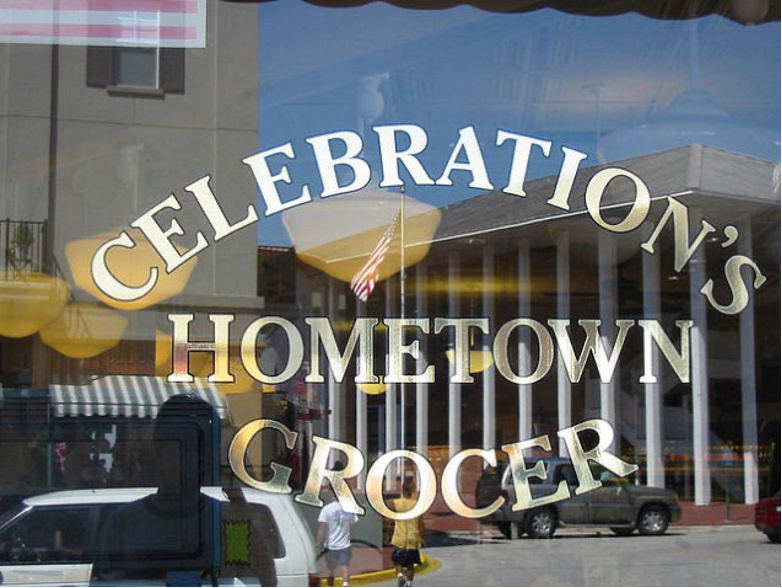
Caption:  Celebration, Florida, is a New Urbanist town deliberately designed and built to look as though it were constructed in a by-gone era.


Caption:  Store in Celebration, Florida.


And, it was against this backdrop that Josh and I had our phone call about Celebration that day.  Josh used the word 'creepy' to describe Celebration.  And, it was not the first time that I had heard Celebration or other Neo-traditional, or New Urbanist, towns and villages described as creepy or scary.


I knew from Social Psychology classes that I had had in college, that feeling that something is creepy or scary, or having feelings of anxiety about something, all revert back to the primary emotion of Fear.  Sure, Josh and his friends did not run screaming out of Celebration, and it is easy to laugh and dismiss the undercurrent of fear, and I think that that is why nobody had addressed it head on up until this point.


But, I felt that if I could unlock what was causing that - albeit subtle -  fear reaction, that creepy feeling, then I could begin to distill how a person's environment affected him or her on a most basic, most primal level.  This is what I had been after - an idea of what people's most natural, most suitable environment would be like!


I put the leash on Jasmine, our husky/German shepherd, and started to walk.  I walked to the end of the block of our modern subdivision, past the almost matching pastel stucco houses around the corner and into the park.  The grass was rough St. Augustine - bred to withstand the hot Florida summers - but even so, patches of weeds and sand dotted the turf.  Plus, there was always the very real danger of fire ants, so Jasmine and I stuck to the bright, new sidewalks.  


She nosed around, and I pondered shiny new towns designed to look old, and primal feelings of fear and love.  And, just as we were passing the basketball courts, I got it!  It came to me!  I figured out what the key was to distilling man's environmental needs, and the idea for this book was born.


Read on...


Wednesday, March 25, 2020

Anyone Here? And, notes on using books as a reward during Work From Home Lockdown...

I have not posted since 2013 when my grandbaby came to live with me.

He's eight now.

Are any of my old blog buddies still around?

I am trying to stay off social media as much as I can, although I am drawn to it because I want to stay informed. But, I am starting to get depressed by all the death.

I have plenty of urban planning reports to write, and I need to work on the bills and the house and the grandson's home-schooling.

Starting today I get 1 point worth $1 for every 1 work task or 10 house tasks that I do. I can spend it on books. I am looking for comfort books at this point. Cozies. I am going to re-read some of my childhood books, and collect them for the grandkids - I am up to 5 1/2 grandkids, by the way.

Did you read any Lois Lenski when you were a kid? (Not to be confused with Lois Lowry.) My favorites were Strawberry Girl and Judy's Journey - but, there are a ton of them.

If you're still out there, comment below please and I will visit your blog! Do you have any other Cozy book ideas?

Friday, March 15, 2013

Anton


The steam rose on the square after the summer rain, and like ghosts, the people of the village drifted back. The sun blazed. Barefoot, Anton ran over the pavers jumping in warm puddles.

Photo Source: Berenger ZYLA/Foter.com/CC BY-NC-ND

I prepared this post so as to participate in this weekend's Trifextra over at TrfectaWritingChallenge.com.

Saturday, February 16, 2013

Trifextra - Welcome to My World

It's difficult for me to participate in Trifextra because I am adrift in a sea of half-done traffic studies. Dirty laundry clogs my engines, and dishes have piled up to create little reefs.

*************
I have written this so as to participate in the weekend writing contest over at TrifectaWritingChallenge.com.

This weekend, we are to write 33 words of hyperbole!

Picture source: www.encore-editions.com

Thursday, February 14, 2013

Trifect Entry - Amy's Story

Amy tried not to dwell on the fact that she was adopted. Of course, she knew. She had always known. For one thing, she was Asian - an almond-eyed exotic orchid in the middle of a family of blond American daisies.

Also, there were the snippets of memory. The little flashes, like scenes from old movies, would usually come when she was lying in bed trying to go to sleep. Amy had been adopted as a three year old. She was twelve now, but she had these vague memories. A smiling Chinese woman - her mother? Mountains. A fall into a cold lake.

Amy tried to suppress the memories. They made her feel lost and lonely, and then guilty, as though she were betraying her family here in America.

So, Amy always did her best not to think about China, until the day that she got the note, and the dragon came crashing through the door.

*********************

I have prepared this post so as to participate in the TrifectaWritingChallenge. click over and take a look! Anyone can participate, and it is a lot of fun and a bit of a writing work out!

This is paraphrased selection from a screenplay I am working on...

Saturday, February 9, 2013

Trifextra: Nabokov Quote


...the eye encountered all sorts of stratagems, such as pale-blue and pink underwear cakewalking on a clothesline, or a lady’s bicycle and a striped cat oddly sharing a rudimentary balcony of cast iron...


Speak, Memory, Vladimir Nabokov

******

I have copied this Nabokov quote so as to participate in the Trifextra Weekend Challenge. This weekend, we are to find a quote of exactly 33 words...

I like this by Nabokov from the end of 'Speak, Memory.' It is serendipitious and fanciful...

Wednesday, February 6, 2013

Trifecta Writing Challenge 63: What Richard Did

"Don't think about it," James told himself as he rode to London. The weather, itself, seemed to share in his misery. Darkness was falling on a grey day. It was drizzling steadily, and a sharp, cold wind compelled Sir James Tyrell to pull his collar up around his neck.

Only one servant rode with him, the loyal Tom. It would have been better to have no witnesses, but he needed one other man for what he was about to do.


The horses plodded on, but neither man spoke as they drew closer to London. There was nothing to discuss. Sir James' path had been set for him when he threw in his lot with Richard III in his bid for the throne.

Everyone knew that sooner or later something would have to be done about the Princes in the Tower. The claim of Richard III would always be questioned as long as the princes were alive.

Sir James had been dreading the day that Richard would summon him about the princes. He knew that as Richard's oldest and most loyal ally, that that day would come, and when it did he was almost grateful for the opportunity to finally do it and end the anxious waiting.

He had not told Tom exactly what they were about to do. He had merely said that the king had ordered them to go to the Tower to see the princes. But, the look of shock, followed by a look of grim resignation that registered on Tom's face let Sir James know that Tom understood their mission.

Far too soon, the lights of London appeared in the distance. Woodenly, James began to instruct Tom. They would use the princes' pillows.


*****************************

This is my entry for this week's Trifecta at http://www.trifectawritingchallenge.com/2013/02/trifecta-week-sixty-three.html

What do you think? Please comment! Also, please consider joining in! It's fun; good writing practice; and you meet cool people!

(Picture Source: Wiki)

Friday, February 1, 2013

Trifextra Week 53: Set 'em Up, And Knock 'em Down


"You help her get the job knowing his weakness for hot girls. He harrasses her; gets fired... You waltz in and take his job."

"You act like I orchestrated it all..."

"Didn't you?"

*********************************

This is my entry for this weekend's Trifextra at TrifectaWritingChallenge.com.

This weekend's contest is to write exactly 33 words of dialogue. What do you think? Please comment! Also, please consider joining in! It's fun; good writing practice; and you meet cool people!

(Picture Source: Wiki)

Wednesday, November 14, 2012

Wondrous Words Wednesday - I'm Back(!)

Sorry that I have been missing in action from blogging. My Wondrous Words today will explain where I have been.

This blog post was written so as to participate in Wondrous Words Wednesday a meme hosted by BermudaOnion.net.

So, as of a few months ago, I am raising a grandchild. Say 'Hi' to Donovan!


See the faint verticle ridge in the middle of his forehead? That is called a "Metopic Ridge." It is caused by the bony plates of the skull closing up too quickly.


Sometimes a metopic ridge is a problem and sometimes it is not. It can lead to the brain not having enough room to grow. One thing the doctor looks for is to see whether the brain is triangular from the top. Look at this photo... This condition is called "Trigonocephaly."

What today's words mean is that the baby will need an operation. But, we are just taking this one day at a time, and I think everything will turn out fine.

Saturday, November 10, 2012

Formula for Winning the Trifecta Writing Challenge


Below is my 33 word submission to the Trifextra Writing Challenge!

This weekend we were to use exactly 33 words to describe a formula! What do you think?

****************


The Ability of the Writer (AW) multiplied by Time/Carefulness (TC), less the AW x TC of the other contestants, all times the unknown "x" (judges' opinions) equals the probability of winning Trifecta!


Photo source: http://www.niemanlab.org

Friday, September 14, 2012

Trifecta Writing Challenge and the Rule of Three

"What's turducken?" asked Alex.

I told him it was a chicken stuffed inside a duck stuffed inside a turkey.

"Hmmm," he mused. "There would still be room for a mouse inside the chicken."


***************

This is my weekend entry for the TrifectaWritingChallenge. Check it out - it's a lot of fun. This weekend we had to do a 33-word piece using the Rule of Three. (Turducken photo source: Wiki).

***************

BTW, sorry I have been MIA for a bit. I inherited a new baby! He is adorable and a lot of work!

Book Review: Hope for Today, Promises for Tomorrow

I was sent a free copy of "Hope for Today, Promises for Tomorrow," in exchange for an honest review. This is a book for people surviving miscarriage and infant loss. it is a faith-based book that can act almost as a workbook to get them through what I would think would be the worst time in their lives.

I think this book was really well done. It is written by a survivor and has ample quotes from other survivors.

It takes the reader through the stages of coming to terms with this horrible loss through faith. At the end of each section there are things for them to journal about. I have seen journaling used in other recovery situations, and I think it is a great tool.

To be honest, I would not have picked this book up on my own because I would not have THOUGHT that I could not relate. I have five kids and am raising a grandchild and have - very thankfully - not experienced this kind of loss.

But, guess what? This book still had a lot of meaning for me. In addition to letting me empathize with other women, it really made me appreciate what I have. At this stage in my life, I am getting up in the middle of the night to feed my infant grandson, and I am tired, and he spits up on me - a lot. Reading this book made me cherish and appreciate him and my own kids even more than I already was - spit up and all...

I am going to hang onto my copy of this book, and when I run across a woman who is going through the trauma of infant loss or miscarriage, I will be able to give it to her as a really useful gift. I would recommend this book for anyone who, sadly, finds themselves in this situation.


Saturday, July 28, 2012

Weekend Cooking - How to Eat Weekends!

I spotted "The Splendid Table's: How to Eat Weekends" on the 'new books shelf' at the library, and knew immediately is was just the thing for Weekend Cooking!

This post was written as part of Weekend Cooking over at BethFishReads.com.  Weekend Cooking is open to anyone who has any kind of food-related post to share: Book (novel, nonfiction) reviews, cookbook reviews, movie reviews, recipes, random thoughts, gadgets, fabulous quotations, photographs. If your post is even vaguely foodie, feel free to head over to Beth Fish Reads, grab the button, and link up anytime over the weekend.  (The button is on your right...)

I am so glad that I picked up this book! It is so fun... I don't know quite how to describe it, but it is almost like a really good magazine full of little articles and sidebars and fun facts - and recipes too, of course. But, having said that, it is much more than a magazine because it is a sumptuous hardcover book with photos that Anthony Bourdain would call hard-core, Triple X food porn!

For example, there is a centerfold(!) type photo that spans two pages and shows the feast they call "A Home Style Vietnamese Sunday Lunch." There are a cucumber and melon salad; little dishes of this and that scattered around; and a platter of Vietnamese Green Mango Salad with Grilled Pork in the Center.

Another example feature is "An Italian Renaissance Supper." I reeeeaally want to make this! As with other cuisines featured in this lush book, the authors dive in and tell us how to outfit an Italian Pantry and Kitchen, and how to build a library of Italian cookbooks.

One of the recipes is for "Renaissance Lasagne!" There are sub-recipes (is that a word?) for Hand-Rolled Egg Pasta and Baroque Ragu. There is a sidebar about wine. And, there is a history lesson called, "The Islam Connection," about how that culture contributed to this recipe and how all this information came down to us through a diary kept of what was served "in the court of the Este dukes in Ferrara." AND, there is a separate "Building a Library" sidebar that goes with the history lesson.

The very first menu featured in the book is called, "A Mexican Comida." And, the very first recipe is, "Tomatillo Salsa with Fresh Cheese from El Cardenal." This is the recipe I made today.

1 medium garlic clove
4 sprigs fresh cilantro
1/2 lb. fresh tomatillos
1 tablespoon onion, coarsely chopped
1/4 teaspoon sugar
1/2 to 2 fresh serrano chiles
salt
8 ounces Queso Fresco (fresh Mexican cheese), feta, farmer, or firm goat cheese, cut into 1/2-inch x 2-inch sticks

1. In a blender or food processor, pulse the garlic, cilantro, tomatillos, onion, sugar and chiles to a very fine mince, until well combined but not entirely liquid. The salsa should have a slightly thickened texture to stand up to the cheese. Add salt to taste.

2. Pour the salsa into a serving bowl. Tuck some of the cheese sticks into it and have the rest on a plate. Set out in the middle of the table and have everyone dip away.


I am sharing photos of the ingredients, but not the "after" photo because, while the salsa was excellent, the Queso Fresco (I got authentic cheese) was crumbly and did not hold together well enough to look pretty. I really plan to make this again and to use chips.

That minor criticism aside, this is such a fun book! I enjoyed reading it and looking at the pictures.

Friday, July 27, 2012

Trifextra Challenge - A Great First Sentence!

Once again, I am taking part in the challenge at TrifectaWritingChallenge.com. Here are the instructions for this weekend's game:

What we want you to do this weekend is to give us a 33-word opening line to your book. That's it. Make us want to read the next 333 pages of your work.


As Victoria poured over the list of countries that did not have extradition treaties with the U.S., she automatically wrote off those that were at war or otherwise unstable; but, the Maldives...interesting.


Thursday, July 26, 2012

Bath Salts! - Chapter 10

This is Chapter 10 of my novel, "Bath Salts." I am entering this post in the challenge at TrifectaWritingChallenge.com where we are to enter a tale of between 333 and 3,333 words.

I am also hooking up with Sandra's Writing Workshop.


CHAPTER 10 (BATH SALTS!)
“How much further?” Randi called to Donovan. They were east of the interstate, driving through what seemed to be endless orange groves. They were on a two-lane country road; the lanes were narrow and the rig took up most of both lanes.
“I’m not a hundred percent sure. I never visited this guy – we don’t hang out.” Donovan replied. “I knew who he was in high school. We were in a couple of classes together. He was a really weird guy. He was really low class and filthy, but you could tell that he was also really smart, but in a creepy way…”
Matt interrupted. “Look. Y’all see that smoke up ahead?”
“Yea, I wonder what that’s all about,” answered Donovan.
As they drove on, a rising cloud of smoke became more and more visible. Suddenly, a battered light blue pickup truck came barreling toward them from the direction of the fire.
“That may be your friend now,” Matt drawled.
He stopped the big rig in the very center of the two-lane road so that the pick-up would not have room to go around on either side. There were deep ditches on both sides of the road, but Mike was not taking any chances of the truck going around him, opening his door, he stepped out onto the semi’s metal stair, and using the door as a shield he looked out the open window and raised his pistol.

Donovan had taken the same stance on the other side of the truck. In front of them, the pickup skidded to a halt. Caroline could see the terrified and confused look of the driver, Billy Knowles, an unkempt, overweight man in his mid-twenties.
Billy threw the truck into reverse and started to speed away from them backward. Matt and Donavan got into the rig, and started after him.
Billy sped backwards and had almost made it to the scene of the fire when he crashed into a particularly deep stretch of ditch on the left side of the road.
He was not hurt, but he was dazed. By the time he got out of the pickup and started to run, Matt and Donovan were out of the rig and after him. He ran into an orange grove and they were right behind him.
“Oh my God, I can’t believe this!” Caroline cried. She and Randi were standing, crouched, in the cab between the two front seats watching the men disappear into the grove. “Should we go with them?”
“I think we should stay,” Randi replied. “We don’t have guns. Bath Salts guy probably has one; I mean...he’s a drug dealer.”
Randi sat down in the passenger’s seat and went on Twitter on her phone.
“Holy crap!” she exclaimed to Caroline, “Venice is totally trending!”
Caroline hit the Twitter icon on her own phone. #Venice was trending, and so were #Zombieapacolypse and #Cannibals.
Meanwhile in the orange grove, Matt and Donovan were running after Billy. The trees in the grove were planted in rows, so they started up the same row. But, when they came to a gap where there was a tree missing, Donovan cut over to the next row, while still in pursuit.
“Billy!” called Donovan.
Billy glanced over his shoulder at Donovan. Without slowing down or raising his gun he yelled, “What do you want?!”

“Answers!” Donovan yelled back.
Billy stopped running and set the gun down near his own feet. Matt and Donavan ran up to him.
He was still doubled over from having set the gun down. He was huffing and puffing with his hands on his knees. “Let me…catch my breath.”
Matt and Donavan stood quietly for a moment. Then Donovan said, “Was it you? Did you put the Bath Salts in the water supply?”
Billy was red-faced and still out of breath. He shook his head ‘No’.
He stood up.
“I remember you, Donovan,” he gasped. “Heard you was a Navy Seal now.”
Donovan nodded.
Billy continued. “No, I didn’t do it. It’s this dumbass named Arnold Hucknett. He told me was going to retire from the City and be a distributor. He said he was having packaging printed up and everything, real professional.”
“I sold him ten huge buckets of the stuff…I didn’t know,” Billy wailed. He started to cry.
Matt and Donavan looked at one another, embarrassed.
“Where is he now, Billy?” Donovan demanded.
“He…he works for the City at the Water Department,” snivelled Billy. “I guess that’s how he done it.”
“I know he lives in the Venice Palms apartments, but I honestly don’t know the apartment number. I never been over there. He has a beat up white pickup with one of those fiberglass bed covers that have the door in back.”
Billy continued. “Look…I didn’t know about the water supply. I would never have sold him the second batch. I heard about the water supply just about five minutes after he took off outta here with the second batch.”
Donavan eyed him sharply. “What do you mean – second batch?”
Billy started babbling again, “I had no idea…”
“Look, cut to the chase, and quit making excuses. We want the short version,” Donovan commanded.


Billy seemed to pull himself together. “He had plastic buckets. They were empty fluoride buckets from the water department. I thought he was just recycling. Maybe I should have…”
“The short version!” barked Donovan.
“Ok, he had ten buckets. He took the two that I had ready last night, and I worked most of last night and got the other eight ready. He came and picked them up just a little while ago. After that is when I…I heard the news on the radio about the water supply. “ Billy hung his head and continued. “I put gas on everything and torched it. Then, I took off, and that’s when I ran into y’all.”
Matt and Donovan looked at one another. Donovan turned back to Billy. “Where’s he going?” he demanded.
“I don’t know!” Billy wailed.
“Do you have any idea how much trouble you’re in already?” Matt demanded.
Billy nodded sadly. “He…Arnold…he was talking about Heidi. She lives in Miami. I think she dumped him. He’s all pissed at her.”
“Billy, do you think he’s going to Miami?” Donavan said with surprising gentleness.
Donovan nodded. “Yea, he was going on and on about getting even with Heidi when he left and after that when I heard what he did in Venice, and he had already left with eight more buckets, I was thinking that he would probably do Miami next.”
“Oh my God…” Matt murmered.
“Let’s go!” said Donovan turning to go back to the truck.
Matt nodded and started after him. “What about Billy?” he called to Donovan.
“His house and lab are burned and his truck’s in a ditch,” Donovan answered back over his shoulder. “I don’t think he is a threat to anyone anymore.”
At that moment, they heard a gunshot behind them. Matt spun around, and Donovan dove for the ground while simultaneously looking back to see what was happening.
They watched as Billy’s body collapsed among the orange trees. The hand holding the gun dropped to his side and then his whole body and what was left of his head slowly went down.
Donovon rose to his feet and dusted himself off. “That’s probably for the best,” he said quietly. “Come on.”
And the two ran back toward the rig.

Wednesday, July 25, 2012

Wondrous Words Wednesday at Wolf Hall!

I am reading "Wolf Hall" by Hilary Mantel! So far it is SO GOOD! I had read that her book, "Bring Up the Bodies" is one of the best books of 2012 (so far), but that it was a good idea to read "Wolf Hall" first. These are books about Tudor England - always a subject I enjoy!


I am not too far into "Wolf Hall," but so far the only words that I have come across that puzzle me are "sweating sickness." Don't laugh! I know what sweating is and I know what sickness is! But...the two together? What does it mean? The book says that every few years the sweating sickness kills a lot of people in London and they die the same day they get it!

I read several articles and found out that nobody really knows WHAT it was. Here is an excerpt from Discover magazine, June 1, 1997:

"Medical historians have never known what caused the sweating sickness. That the disease was neither plague nor typhus was clear from contemporary accounts. Its victims bore neither the boils typical of plague nor the rash of typhus. Now physicians Vanya Gant and Guy Thwaites, both of St. Thomas’ Hospital in London, think they may have identified the killer. Sudor Anglicus, they say, may have been an early version of a disease that has made headlines in recent years: hantavirus pulmonary syndrome, which erupted in the Four Corners region of the American Southwest in the summer of 1993."

I have written this post so as to participate in Wondrous Words Wednesday at BermudaOnion.net.

Monday, July 16, 2012

Review: "The Katyn Order" by Douglas W. Jacobson


We all know from high school that as Nazi Germany was losing the Second World War, the Russians pressed in from the east, and the Americans, English, and French pressed in from the west. They all met in Berlin...the Battle of Berlin ensued...Hitler offed himself...game over.

But, within that sweeping saga, there were, or course, a myriad of sub-plots, that we may not have learned about. "The Katyn Order" is one such story.

Before I say anything else though, I have to tell you that this is not a history lesson (even though you will naturally pick up a lot of information along the way). I think that it can best be described as a thriller and a romance.

It is the story of a male and a female operative in the covert Polish army. They are trying to expel the Nazis from Warsaw toward the end of the war. Basically, they are wedged between two enemies - Germany and Russia.

Under desperate circumstances, a romance develops. It seems to me that these wartime romances are often very powerful because of the dramatic backdrop of the times...the adrenalin.

The two end up on a mission together - to find and retrieve the Katyn Order - an order by Stalin at the beginning of the war that called for the murder of 20,000 Poles. So, it really is an action-packed thriller, as the two race around Poland searching for the order and battling first Germans and then Russians!

I REALLY liked this book! I received it for free in the mail in exchange from an honest book review on my blog, and I have to say that it one of the most well-written of this type of book that I have gotten.

The transitions from one character's story and another are very smooth...actually the whole book is very smooth. It flows well with no choppiness. The characters are believable and complex. I came to really care about 'the good guys.'

I feel as though the cities of Warsaw and Krakow were characters in the book. Warsaw was leveled by the Germans because the people did not surrender, where Krakow's buildings mostly survived. I did some checking and have found that, happily, a lot of Warsaw has been re-built in its original style.

I would definitely recommend this book to anyone interested in thrillers, romances, or WWII-era history!

Saturday, July 14, 2012

Mysterious Weekend Cooking

I have missed the last couple Weekend Cookings. Been busy with work and - truth be told - I have also been goofing around on Twitter quite a bit! I was telling my dad - it's like going to TwitterTwitter Land and hanging out on the Island of Lost Boys and Girls...you can get sucked in and time passes...

But, I did discover www.mysterloverskitchen.com! Somebody Tweeted about it! It is a lot of fun; a lot of mystery writers blogging and sharing recipes. Try to check it out if you get a minute!

This post was written as part of Weekend Cooking over at BethFishReads.com.  Weekend Cooking is open to anyone who has any kind of food-related post to share: Book (novel, nonfiction) reviews, cookbook reviews, movie reviews, recipes, random thoughts, gadgets, fabulous quotations, photographs. If your post is even vaguely foodie, feel free to head over to Beth Fish Reads, grab the button, and link up anytime over the weekend.  (The button is on your right...)


I made a recipe from the site!

Lucy Burdette's Broccoli Rabe and Sausage Pasta

Ingredients:

1 bunch broccoli rabe, washed and chopped into one-inch pieces (discard tough ends and any yellow leaves( - (Libby's note - I left mine long because I thought it would look better!)
1 package Aidell's Italian chicken sausage (4 links) or other to your taste
2 cloves garlic, chopped
1/2 cup chicken broth
1/2 box sturdy pasta such as ziti or rotelli
Parmesan cheese, freshly grated

Slice the sausage into rounds and fry it in olive oil (1-2 Tbsp) until brown and crispy. Remove to a bowl. Saute the garlic in the same pan for 45 seconds, then add the chopped broccoli rabe and the chicken broth. Steam until bright green but still a little crunchy. Add the sausage back in and heat. Hot pepper flakes could be added here if you like a little more zip.

Serve over pasta with lots and lots of freshly grated Parmesan cheese and salt and pepper to taste.

Below is a picture of the finished product. Everyone liked it except one of the kids who was horrified by the liberal use of broccoli!